
In its final year of implementation, the European SENATOR project is achieving successful pilots in Zaragoza and conducting insightful simulations in Dublin. These cities, designated as Urban Living Labs, are testing solutions in real-world environments with the aim of enhancing efficiency, replicability, and sustainability.
Despite initial challenges from the COVID-19 pandemic and new data protection regulations, SENATOR has navigated various obstacles that affected development timelines and is making significant progress towards its final phase. This demonstrates SENATOR’s remarkable adaptability in meeting its goals.
Navigating Regulatory and Technological Challenges
.
The completion of the route optimization algorithm by the University of Deusto team and the implementation of the dashboard by DOTGIS at the beginning of the year have enabled the start of the project’s pilots and simulations, as well as the collection of initial data on the algorithm’s efficiency.
To address limitations such as data anonymization, standardization, and normalization, the project has incorporated various additional technological developments to adequately integrate the information into the platform. These efforts, led by the University of Deusto and the Correos technology team, include everything from anonymizing data and geolocating shipments to integrating real-time route information.
“Numerous technological developments were necessary to support the optimizer and launch the pilots, but we knew innovation is complex, and we are very grateful for the teams’ efforts,” explains Ángela Núñez, coordinator of SENATOR.
Success in Route Optimization Simulations in Zaragoza
.
Within the framework of the pilots in Spain, preliminary tests of the route optimization system have confirmed the algorithm’s proper functioning, showcasing its significant ability to enhance logistics route management efficiency.
For the development of this pilot, various pre-established routes for temperature-controlled deliveries were compared with those generated by the SENATOR platform, considering different scenarios and various constraints such as delivery order, time slots, and delivery times, among others.
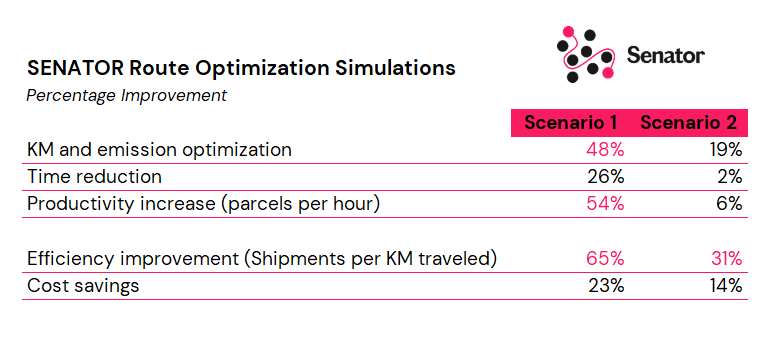
Under identical constraints, in the most favourable scenario, the algorithm increased productivity by 54%, reduced km travelled by 48%, and improved efficiency by 65%, thereby optimizing logistics operations in a sustainable and cost-effective manner.
“These results underscore the potential of SENATOR to enhance operational efficiency and productivity. Although it has not yet been tested in the daily operations of the logistics operator, the theoretical results are promising,” notes Núñez.
Following this theoretical phase of algorithm training, efforts are now focused on the ability to adjust and modify delivery routes in real time to address unforeseen changes in daily operations. This involves developing the functionality to incorporate additional orders into ongoing routes as part of a dynamic re-planning of delivery routes.
Digital Transformation of Urban Infrastructure in Dublin
.
In Dublin, the pilot project for Virtual Kerbside Management, started in October 2022, has been selected as one of the 35 exemplar transport projects under Ireland’s National Pathfinder Programme by Department of Transport. This programme forms a key part of the implementation of the National Sustainable Mobility Policy Recommendations.
Led by Dublin City Council (DCC) as part of SENATOR Project, this initiative involves creating a digital and dynamic map of kerbside assets including city’s loading and unloading zones. The SENATOR platform now have an inventory of more than 15 unique assets with 4000+ data points for 60+ kerb kilometre.
Additionally, as a part of the pilot project Digital Loading Bays and with the recommendations from the city’s transport and An Post teams, DCC have installed 49 sensors in nine strategically identified locations in congested loading and unloading areas, offering real-time availability updates via a web platform and mobile application. This technology allows delivery drivers to head towards available points, reducing traffic caused by vehicles looking for spaces and hence, reducing the air pollution.
The Dublin pilots (kerbside management and Urban consolidation centres) has now also been included as the case studies in the National Demand Management Strategy (Moving Together Strategy) by Department of Transport with one of the key actions to ‘Build upon Senator Project Output’.
Progress and Future Directions in SENATOR implementation
.
In the coming months, the development of the pilots will continue, along with the analysis of results and the calculation of the necessary indicators to evaluate the SENATOR technology and its value in improving the cities of Dublin and Zaragoza.
As part of the Zaragoza pilots, Correos and Correos Express are preparing to conduct the real-world pilot in Zaragoza. This will enable the measurement of the efficiency of collaboration between the two networks in daily operations. The process will assess the impact on operational times and efficiency, as well as address challenges related to information integration and real-time management.
In Dublin, as the pilots continues, the SENATOR partners An Post and Dublin City Council, plan on streamlining the theoretical trials using available data sets on city infrastructure (kerbside maps), parcels deliveries (data from An Post) and route optimization to test multiple scenarios. This will provide us an opportunity to test out different scenarios in an urban environment on SENATOR Platform.
The SENATOR Project has brought together multiple stakeholders in the logistics sector in both Zaragoza and Dublin, thus, providing an opportunity to work towards a common goal of a greener city.